Mo chràdhghal bochd
mar a tha mi nochd
's mi gun tamh, gun fhois, gun sunnd.
Gun sùrd ri stàth,
gun dùil ri bhith slàn,
chaidh mo shùgradh gu bràth air chùl.
Mu dheagh mhac Ruairidh nan long,
làmh a libhrigeadh bhonn
's a bha measail air fonn luchd-ciùil.
'S e bhith smuaineachadh ort
a chràidh mi am chorp
is a chnàmh na roisg bho m' shùil.
Mi ri smuaintean bochd truagh
is ri iomradh baoth buan,
's mi gad ionndrainn-sa bhuam, 's tu b'fhiù.
Deagh shealgair am frìth
bha gun cheilg do thaigh rìgh,
agus seirbheiseach dìleas crùin.
Tha do chinneadh fo ghruaim
's gach aon fhine m'an cuairt
o'n la ghrinnicheadh d'uaigh 's a' chrùist.
Mu 'n t-sàr-ghaisgeach dheas threun
ann am batail nan ceud
cha bu lapach 's an leum od thu.
Làmh churanta chruaigh
ann an iomairt 's gach buaidh;
chan urrainn domh d'uaisle, rùin.
Do thaigh-talla fo ghruaim
's e gun aighear gun uaill
far 'm bu mhinig a fhuair sinn cuirm.
My sad, tormented weeping -
I am weeping before you;
I cannot rest, I have no peace, no joy.
I cannot make myself do anything,
I cannot imagine being healthy,
All the pleasure I used to take in life has gone.
For Ruairidh son of the great ships,
a man generous to singers,
who respected our songs, is no more.
It is thinking of you
which has tortured my flesh.
It has chewed the eyelids from my eyes.
My thoughts are sorrowful and wretched.
I think of you, I miss you, it's no use
but you are worthy of such thoughts.
Skilled hunter in the deer-park
and loyal to the royal house,
an honest-hearted servant of the Crown.
Your family are in mourning,
as is everyone around you,
since your coffin was made ready in the vault.
First among heroes
in the battle of hundreds,
you were never one to fumble or to falter.
Your hand stern and brave,
in every battle winning victory -
I will get no more support from your gentlity.
Now your great house is in gloom,
with no pomp and no merriment.
Once we were feasted there.
This song has a piercing tune to accompany it, sung in falsetto before sinking into a mournful tenor. It takes immense control to sing it, which is one of the paradoxes of the song - discipline and abandonment, words of deep personal loss combined with the formal compliments of courtly elegy.
Sunday, October 16, 2005


Postcards from Hitler
Let the Thunder Roll
I knew Stalin and knew him well.
Churchill even worse - not a new European.
Destroying you all was everything I craved.
Nobody left except the buttercups and milk of Germany.
In years to come, I imagined volk in pretty houses
installing old-fashioned Bakelite telephones
out of sheer nostalgia.
To me, it's an entirely putrid idea
because they don't match digital technology.
I don't want V2 rockets.
Fetch me nuclear power and fetch me Stalingrad.
31 March 1998
Brown Stamps Forever
We would sit alone in the Eagle's Nest
and spank and lie and speak about the business
of the future of the universe - one long poem unburdened
by myth and more black and white films than you care to name.
We never appreciated homosexuals and we never allowed in Negroes.
There was a repetitious repetition of everything indeed.
Take your Satchmo and your Bessie back to where they came from.
There is a direness in my white sky. There is firmness in my purity.
And only I believe it.
31 March 1998
Barry MacSweeney (1948 - 2000)
These are two poems from his Selected Poems Wolf Tongue, which you can buy here.
I knew Stalin and knew him well.
Churchill even worse - not a new European.
Destroying you all was everything I craved.
Nobody left except the buttercups and milk of Germany.
In years to come, I imagined volk in pretty houses
installing old-fashioned Bakelite telephones
out of sheer nostalgia.
To me, it's an entirely putrid idea
because they don't match digital technology.
I don't want V2 rockets.
Fetch me nuclear power and fetch me Stalingrad.
31 March 1998
Brown Stamps Forever
We would sit alone in the Eagle's Nest
and spank and lie and speak about the business
of the future of the universe - one long poem unburdened
by myth and more black and white films than you care to name.
We never appreciated homosexuals and we never allowed in Negroes.
There was a repetitious repetition of everything indeed.
Take your Satchmo and your Bessie back to where they came from.
There is a direness in my white sky. There is firmness in my purity.
And only I believe it.
31 March 1998
Barry MacSweeney (1948 - 2000)
These are two poems from his Selected Poems Wolf Tongue, which you can buy here.
For now being come to the altar, where as priest
Death ministering should meet her, and his hand
Seal her sweet eyes asleep, the maiden stood,
With light in all her face as of a bride
Smiling, or shine of festal flame by night
Far flung from towers of triumph; and her lips
Trembled with pride in pleasure, that no fear
Blanched them nor death before his time drank dry
The blood whose bloom fulfilled them; for her cheeks
Lightened, and brighter than a bridal veil
Her hair enrobed her bosom and enrolled
From face to feet the body's whole soft length
As with a cloud sun-saturate; then she spake
With maiden tongue words manlike, but her eyes
Lit mildly like a maiden's: Countrymen,
With more goodwill and height of happier heart
I give me to you than my mother bare,
And go more gladly this great way to death
Than young men bound to battle. Then with face
Turned to the shadowiest part of all the shrine
And eyes fast set upon the further shade,
Take me, dear Gods; and as some form had shone
From the deep hollow shadow, some God's tongue
Answered, I bless you that your guardian grace
Gives me to guard this country, takes my blood,
Your child's name, to heal it. Then the priest
Set to the flower-sweet snow of her soft throat
The sheer knife's edge that severed it, and loosed
From the fair bondage of so spotless flesh
So strong a spirit; and all that girt them round
Gazing, with souls that hung on that sad stroke,
Groaned, and kept silence after while a man
Might count how far the fresh blood crept, and bathed
How deep the dark robe and the bright shrine's base
Red-rounded with a running ring that grew
More large and duskier as the wells that fed
Were drained of that pure effluence: but the queen
Groaned not nor spake nor wept, but as a dream
Floats out of eyes awakening so past forth
Ghost-like, a shadow of sorrow, from all sight
To the inner court and chamber where she sits
Dumb, till word reach her of this whole day's end.
Algernon Charles Swinburne (1837 - 1909), from Erectheus - a tragedy
Abkhaz girl
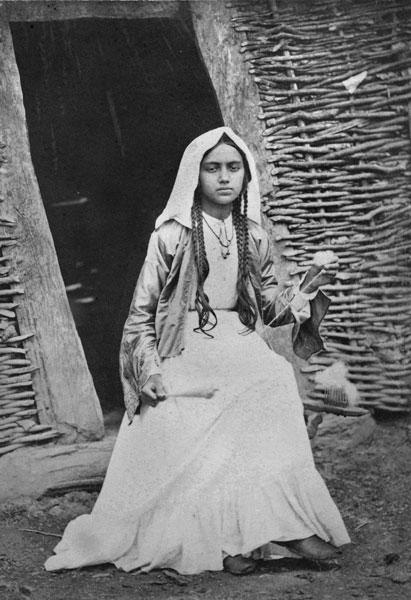
This picture is from a beautiful series of photos from the Caucasus, displayed on the website of the Kunstkammer museum in St. Petersburg. It can be seen in context at www.kunstkamera.ru/exhibition/kavkaz/eng/frame.html. The Kunstkammer is the oldest museum in Russia, founded in 1704 by Peter the Great, who collected interesting objects on his travels through Europe, and eventually made them into a permanent exhibition of curious or beautiful things.

Oh, oh.
There was an old woman who lived in a shoe
And she had so many children she didn't know what to do.
So she gave them some broth without any bread
And whipped them all soundly and sent them to bed.
And she had so many children she didn't know what to do.
So she gave them some broth without any bread
And whipped them all soundly and sent them to bed.

Henry House
The jolly old man is a silly old dumb,
with a mean face, humped, who kills dead.
There is a tall girl who loves only him.
She has sworn - Blue to you forever.
Grey to the little rat, go to bed.
- I fink it's bads all over.
Goguel says nobody knew where the christ they buried him
anyway but the Jewish brass.
No use asking the rich man.
A story. Stories??
One of these bombs costs a fortune.
So sweet dawn wàs he gone?
A bloody fortune!
Married her donkey? That can hardly be.
Magics sweat up & down.
Henry & Mabel ought to be but can't.
Childness let have us, honey,
so adult the hell don't.
John Berryman
with a mean face, humped, who kills dead.
There is a tall girl who loves only him.
She has sworn - Blue to you forever.
Grey to the little rat, go to bed.
- I fink it's bads all over.
Goguel says nobody knew where the christ they buried him
anyway but the Jewish brass.
No use asking the rich man.
A story. Stories??
One of these bombs costs a fortune.
So sweet dawn wàs he gone?
A bloody fortune!
Married her donkey? That can hardly be.
Magics sweat up & down.
Henry & Mabel ought to be but can't.
Childness let have us, honey,
so adult the hell don't.
John Berryman

The Prayer of Erzsebet
Help me, O Clouds,
O Clouds, stay by me.
Let no harm come to me.
Let me remain healthy and invincible.
Send, O send, you powerful Clouds, ninety cats
I command you, O king of the Cats, I pray you.
May you gather them together,
even if you are in the mountains,
or on the waters,
or on the roofs,
or on the other side of the ocean.
May these ninety cats appear to tear and destroy
the hearts
of kings and princes,
and in the same way
the hearts
of teachers and judges
so that they shall harm me not.
Holy Trinity, protect me.
O Clouds, stay by me.
Let no harm come to me.
Let me remain healthy and invincible.
Send, O send, you powerful Clouds, ninety cats
I command you, O king of the Cats, I pray you.
May you gather them together,
even if you are in the mountains,
or on the waters,
or on the roofs,
or on the other side of the ocean.
May these ninety cats appear to tear and destroy
the hearts
of kings and princes,
and in the same way
the hearts
of teachers and judges
so that they shall harm me not.
Holy Trinity, protect me.
Saturday, October 15, 2005

Bàrdachd mu ròsan
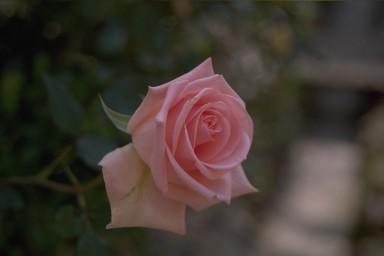
A mosque is a rose.
We look up at the sky, describe the pictures in the clouds.
What is paradise? It is a scorching fire.
Ashes of roses.
He wept at the door, it was a shabby-looking place,
an end of terrace.
The Earth is a mosque, but its petals are shattered.
from Alcoholic Rose Gardener
We look up at the sky, describe the pictures in the clouds.
What is paradise? It is a scorching fire.
Ashes of roses.
He wept at the door, it was a shabby-looking place,
an end of terrace.
The Earth is a mosque, but its petals are shattered.
from Alcoholic Rose Gardener
Theatre State
from Martial's De Spectaculis Liber
Quae tam seposita est, quae gens tam barbara, Caesar,
ex qua spectator non sit in urbe tua?
venit ab Orpheo cultor Rhodopeius Haemo,
venit et epoto Sarmata pastus equo,
et qui prima bibit deprensi flumina Nili,
et quem supremae Tethyos unda ferit;
festinavit Arabs, festinavere Sabaei,
et Cilices nimbis hic maduere suis.
crinibus in nodum tortis venere Sygambri,
atque aliter tortis crinibus Aethiopes.
vox diversa sonat populorum, tum tamen una est,
cum verus patriae diceris esse pater.
What nation is so remote and primitive, Caesar, that there isn't at least one of them here in Rome? A Balkan farmer from the sacred peaks, a Romanian-Iranian brought up on horse blood, or a man who drinks water at the source of the Nile, or a man lashed by waves at the edge of the world.* The Arabs make their way here, even from Yemen. Armenians come as well, splashing themselves with cologne. The Germans are here with their hair knotted-up, Ethiopians too with that strange curly hair. One hears a multitude of different languages but we speak with one voice, when you, Caesar, are hailed true father of the nation.
* the British
Turba gravis paci placidaeque inimica quieti,
quae semper miseras sollicitabat opes,
traducta est getulis nec cepit harena nocentis:
et delator habet quod dabat exilium.
A group of people who endanger the peace, and cannot live in a calm or contented way, who merely make heavier the burden of our wealth - these were led in the arena, and the vast arena had insufficient room for the guilty! Now they take the punishment they used to deal out, and the blackmailer flies into exile.
Prostratum vasta Nemees in valle leonem
nobilis Herculeum Fama canebat opus.
prisca fides taceat: nam post tua munera, Caesar,
haec iam feminea vidimus acta manu.
Hercules is famous for laying out a lion in Nemea, but ancient fortitude is no match for ours. Thanks to your shows, Caesar, we have seen what armed women can do.
Qualiter in Scythica religatus rupe Prometheus
assiduam nimio pectore pavit avem,
nuda Caledonio sic viscera praebuit urso
non falsa pendens in cruce Laureolus.
vivebant laceri membris stillantibus artus
inque omni nusquam corpore corpus erat.
denique supplicium dignus tulit: ille parentis
vel domini iugulum foderat ense nocens,
templa vel arcano demens spoliaverat auro,
subdiderat saevas vel tibi, Roma, faces.
vicerat antiquae sceleratus crimina famae,
in quo, quae fuerat fabula, poena fuit.
As Prometheus on his rock in Scythia fed a bird with his own chest, so Laureolus, on a real cross, fed a wild pig with his own flesh. His dripping limbs were cut to pieces, but he still remained alive till he had no body left. It was what he deserved after all, he'd cut his father's throat, or maybe his owner's, or was it that he'd stolen the gold from a temple or set off explosions? But the end was something better than a story - what was once just a play became a real execution!
Lambere securi dextram consueta magistri
tigris, ab Hyrcano gloria rara iugo,
seava ferum rabido laceravit dente leonem:
res nova, non ullis cognita temporibus.
ausa est tale nihil, silvis dum vixit in altis:
postquam inter nos est, plus feritatis habet.
A female tiger from the mountains of Hyrcania, who used to lick the hand of her trainer, attacked a wild lion and tore it to pieces. It was something really new, unprecedented! She would never have dared to do that when she lived in the forests, but since living among us, she has grown in ferocity.
from Marcus Valerius Martialis, Epigrams Vol. 1 in the Loeb Classical Library.
The translations I changed a bit. I feel the Latin writers of the Silver Age speak very powerfully to us now. Lucan, Seneca - and Martial. They sink their heads in the corruption of the age, and even when they seem to be smiling defiantly, one feels their discontent and pain. These poems were written to comment on shows in the arena. I often wonder what Martial could have meant by them.

A Japanese poem
いつまでも生きてゐる氣の顔ばかり
From their faces, they are going to live forever
from 'Senryu', translated by R.H. Blyth
From their faces, they are going to live forever
from 'Senryu', translated by R.H. Blyth
Hilarious

It's strange what some people find funny. I remember seeing a review of Lolita which said how enormously funny the book was. Was that just a matter of nerve? Was the reviewer too frightened, too much of a moral coward, to be serious? Actually, maybe comedy should move beyond the reflex-response of making people laugh, and go for a high-wire act of not getting a single laugh from anybody. My favourite game as a kid was sausages. Whenever Gegen die Wand/Head On was funny, I felt mixed in with the laughter a kind of excitement, a jealous yearning to be there and belong inside the film. It's quite a dangerous feeling; it almost becomes a fan mentality, a sort of hatred. Wasn't it strange on the Bob Dylan documentary how hateful a lot of the fans were, how snidely mocking? I remember listening to a bootleg recording of a Nirvana gig - Kurt screams. "Louder!!" shouts the audience. He screams again. "Louder!" And then out comes the cello, and they start whistling and jeering. The moral compass of Gegen die Wand is the traditional singer we see right at the beginning of the film. As the film goes on she is too annoyed and frustrated to sing, and she sits down in a resigned refusal to join in with the mixed-up lives on the screen. She is honest and concerned, she is observant like the statue of a presiding goddess, but she is too self-contained to be jealous of the unhappy lives before her. She sings again at the end. There's something eerily philosophical in the way she sings and interacts with the film.
The other films I've been reviewing are funny as well. The funny scenes in The Mirror are mixed with anxiety, either for the child, or the integrity of the film. A Joe d'Amato film like Buio Omega is something that inflicts itself upon the viewer, it ruins one's evening like a piece of raw, drunken honesty. Should I laugh, or will it just get me beaten up? And the strange thing about Punishment Park is that although it is often very funny as well, the distraction of laughter doesn't unbalance the film's moral purpose, our laughter is never complicit and it doesn't blunt our outrage and anger. How does it manage that? There seems something miraculous about it, and the only thing I can think of to explain it is the moral goodness of the director.
Friday, October 14, 2005
A film by Jafar Panahi

The director of 'The White Balloon', Jafar Panahi, also made 'The Mirror' with the same leading actress, Aida Mohammadkhani. Of course, lots of Iranian films have cute children, and at the start of this film Mohammadkhani looks especially cute with a cast on her arm. But in 'The Mirror', the sentimentality is done with, the script is jarred open, and director and leading actress, adult and child, perform an eerie game on the streets of Tehran, a game of dare, of catching and letting fall, of risk and indifference.
In many countries reknowned for their cute children, the children themselves can have extremely hard lives. This sentimentality about childhood does nothing to alleviate the suffering, and at worst provides a pretty aesthetic frame for exploitation. But then, in adult eyes, the poor child can only play the picturesque victim.
But what happens if the child writes the scenario themselves? 'The Mirror' is a fascinating bridge to Panahi's third film 'The Circle', as piercing and unexploitative film as it's possible to imagine. I believe he has spoken himself about 'The White Balloon', 'The Mirror' and 'The Circle' forming a vague trilogy.
It's a pity that 'The Mirror' doesn't get talked about so much; I don't think it's even been released in England. I bought it from amazon in the States.
Buio Omega
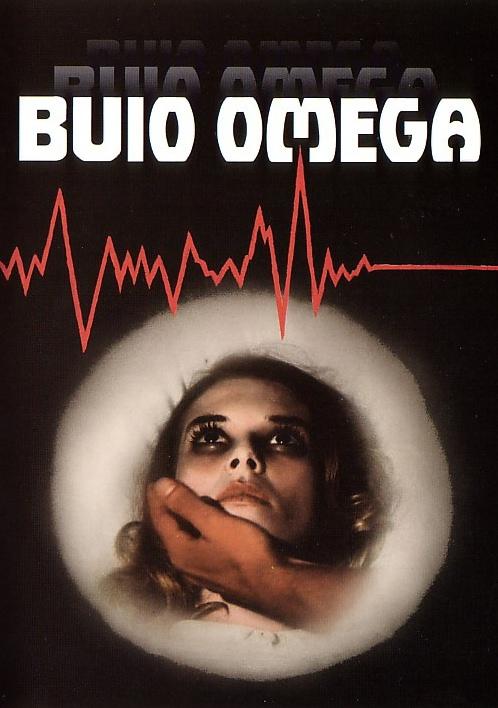
A film by Joe d'Amato, who mostly made horror and porn films, but who recklessly spoke the truth. One can either have nothing to do with the commercial world, and attack and reject it, or, like d'Amato, swim so low in the commercial sink, with so little to play for, that one gains a strange sort of freedom. A freedom, like a child, to see his dreams through to their logical conclusions, without diversions or dishonesty.
This film is about a man in love with his dead wife, who like a lot of men prefers her to be dead. The film is seen through the eyes of that woman, and asks what it means to be desired by a man. Buio Omega has been criticised for lacking poetry, for being cheaply shot, for smothering everything with vulgar blood and entrails, and it is a very vulgar film. But that is a function of its peasant honesty and its materialism - no gauze and dry ice in a d'Amato film to mask what lies underneath desires and dreams: we're made of flesh and bone, not poetry.
There is a lovely satirical scene at the engagement lunch - d'Amato is very fond of his grotesques. Is it well-acted or not? Is it well-paced and structured? It doesn't matter. Joe d'Amato is too honest to care much about such things, and besides he has a child-like love of the forbidden - like shooting a scene with the sun in front of the camera, he never tires of that. His films are not well-made or well-furnished; they are better than that. His Buio Omega and Emanuelle in America together say everything Eyes Wide Shut could not, for all Kubrick's formal ingenuity. The only subject that film has left is its own remoteness and the emptiness of its fantasies.
But as d'Amato knew, sex scenes smell, and there are always suffering, material people beneath the surface sheen. But as a maker of Z-grade films, he speaks from a truly abject artistic position - even the horror fans are a cut above watching a d'Amato pic. His films should have died in the year they were made, but they still persist, and in spite of themselves people still find a reckless, humiliating truth in them which no other films quite provide.

A couple of words to poets to come
We had no time to write of love
Though we were impetuous lovers,
The country needed songs of freedom,
The country needed songs of grain ripening in the fields.
The country demanded of us poor poets
That we teach courses to fight illiteracy,
That we build dams on the rivers,
That we light the flame of socialism in the mountains.
Do not wonder, oh poets yet to be born,
And do not judge us for what we have not accomplished.
Compared to you, we will look like simple monks
Laden with grain and heavy iron chains.
We, who spent many a sleepless night,
We, who accomplished many a great deed,
Could we not at least have written a couple of love poems,
Could we not have stammered, 'Oh, my beloved?'
Do not believe we were heartless! If only you could have seen
The passions we felt for the girls we loved and heard
What sweet nothings we whispered in their ears on those radiant
Evenings! But we lacked the time to publish those sweet nothings.
Our printers were busy with more important things.
Dritero Agolli (1931 - )
translated by Robert Elsie from "An Elusive Eagle Soars" UNESCO/Forest Books
The Albanian communist leader Enver Hoxha refused to recognise the "de-Stalinization" of the Soviet Union, for many reasons - out of fear for his own position, resentment of Russian interference, perhaps too out of stubborness and twisted principle.
Dritero Agolli was president of the Union of Writers and Artists, and a sincere communist. I think this poem is a fascinating marriage of "socialist realism" and emotional ambiguity.
Though we were impetuous lovers,
The country needed songs of freedom,
The country needed songs of grain ripening in the fields.
The country demanded of us poor poets
That we teach courses to fight illiteracy,
That we build dams on the rivers,
That we light the flame of socialism in the mountains.
Do not wonder, oh poets yet to be born,
And do not judge us for what we have not accomplished.
Compared to you, we will look like simple monks
Laden with grain and heavy iron chains.
We, who spent many a sleepless night,
We, who accomplished many a great deed,
Could we not at least have written a couple of love poems,
Could we not have stammered, 'Oh, my beloved?'
Do not believe we were heartless! If only you could have seen
The passions we felt for the girls we loved and heard
What sweet nothings we whispered in their ears on those radiant
Evenings! But we lacked the time to publish those sweet nothings.
Our printers were busy with more important things.
Dritero Agolli (1931 - )
translated by Robert Elsie from "An Elusive Eagle Soars" UNESCO/Forest Books
The Albanian communist leader Enver Hoxha refused to recognise the "de-Stalinization" of the Soviet Union, for many reasons - out of fear for his own position, resentment of Russian interference, perhaps too out of stubborness and twisted principle.
Dritero Agolli was president of the Union of Writers and Artists, and a sincere communist. I think this poem is a fascinating marriage of "socialist realism" and emotional ambiguity.

Gegen die Wand

Sibel is admitted to a psychiatric ward after trying to kill herself. She has no feeling of freedom or direction in life and her family cloys on her. So she arranges to marry another Turkish in-patient, Cahit, who drove his car into a wall. Dolled-up and put in a suit, he makes a passable son-in-law, and Sibel tries to live a free life away from the eyes of her father and brother. The film tracks the mutual collision of Sibel and Cahit.
Every scene, every line in this film is a cliché - or rather, it flowers out of cliché. It's directed in a hard-driving MTV style, (although the music kind of predates that - a Birthday Party track from Prayers on Fire, for example - ) and so the whole film should have this sheen of fake. Except it doesn't. Gegen die Wand speaks the truth - bitterly, fiercely, exultantly. It so refuses to lie that the ending is disappointing and unsettling; our lust for tragedy is neither sated nor archly refused. In a highly mediated environment, in a media hall of mirrors, we don't become any less human, our skin doesn't turn into plastic. Most films take refuge in a fantasy of vacuum-sealed, affectless horror. Head On doesn't kick through the glass screen exactly, but it's a warm-blooded creature, scampering about under the floorboards and fighting to survive.
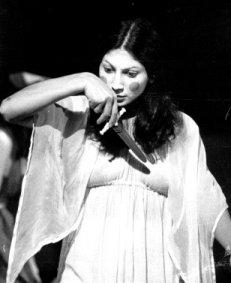
Picture of Sibel Kekilli
Subscribe to:
Posts (Atom)
