As I was walking
I came upon
chance walking
the same road upon.
As I sat down
by chance to move
later
if and as I might
light the wood was,
light and green,
and what I saw
before I had not seen.
It was a lady
accompanied
by goat men
leading her.
Her hair held earth.
Her eyes were dark.
A double flute
made her move.
'Oh love,
where are you
leading
me now?'
Robert Creeley
Saturday, October 22, 2005


A Bad Morning
The silver poplar, a beauty of local fame
An old hag today. The lake
A puddle of dirty suds - do not touch:
The fuschia among the snap dragons cheap and vain.
But why?
Last night in a dream I saw fingers pointing at me
As at a leper. They were callous, stained with work and
They were broken.
You don't know! I cried,
Conscious of guilt.
Bertoldt Brecht
An old hag today. The lake
A puddle of dirty suds - do not touch:
The fuschia among the snap dragons cheap and vain.
But why?
Last night in a dream I saw fingers pointing at me
As at a leper. They were callous, stained with work and
They were broken.
You don't know! I cried,
Conscious of guilt.
Bertoldt Brecht
Friday, October 21, 2005

I remember
It was my bridal night I remember,
An old man of seventy-three
I lay with my young bride in my arms,
A girl with t.b.
It was wartime, and overhead
The Germans were making a particularly heavy raid on Hampstead.
What rendered the confusion worse, perversely
Our bombers had chosen that moment to set out for Germany.
Harry, do they ever collide?
I do not think it has ever happened,
Oh my bride, my bride.
Stevie Smith
An old man of seventy-three
I lay with my young bride in my arms,
A girl with t.b.
It was wartime, and overhead
The Germans were making a particularly heavy raid on Hampstead.
What rendered the confusion worse, perversely
Our bombers had chosen that moment to set out for Germany.
Harry, do they ever collide?
I do not think it has ever happened,
Oh my bride, my bride.
Stevie Smith
Mischief
'Oh,' he said, 'I have lived with nothingness
so long it has lost its meaning.
I have said "yes" to the universe
so many times its echoes
have returned increasingly as "no".
I have developed my negatives
of the divine and preserved their technicolour
in a make believe album. I realise
the imagination is alive only
in an oxygenated world. The truth
is less breath-taking than the vacuum
into which it withdraws. But against
all this I have seen the lamb
gambolling for a moment, as though
life were a good thing. This, I have said,
is God's roguery, juggling
with the scales, weighting the one
pan down with evil piled
upon evil then sending it suddenly
sky-high with in the other a tear
fallen from the hardest of eyes.
R. S. Thomas (1913 - 2000)
so long it has lost its meaning.
I have said "yes" to the universe
so many times its echoes
have returned increasingly as "no".
I have developed my negatives
of the divine and preserved their technicolour
in a make believe album. I realise
the imagination is alive only
in an oxygenated world. The truth
is less breath-taking than the vacuum
into which it withdraws. But against
all this I have seen the lamb
gambolling for a moment, as though
life were a good thing. This, I have said,
is God's roguery, juggling
with the scales, weighting the one
pan down with evil piled
upon evil then sending it suddenly
sky-high with in the other a tear
fallen from the hardest of eyes.
R. S. Thomas (1913 - 2000)

Tuesday, October 18, 2005

It was like a fine, bloody thread being pulled through their hearts
Who are you?
The spider clamps the bluefly - whose death panic
Becomes sudden soulful absorption.
A stoat throbs at the nape of the lumped rabbit
Who watches the skylines fixedly.
Photographs of people - open-mouthed
In the gust of being shot and falling
And you grab me
So the blood jumps into my teeth
And 'Quick!' you whisper, 'O quick!'
And 'Now! Now! Now!'
Now what?
That I hear the age of the earth?
That I feel
My mother lift me up from between her legs?
Ted Hughes, from 'Gaudete'
The spider clamps the bluefly - whose death panic
Becomes sudden soulful absorption.
A stoat throbs at the nape of the lumped rabbit
Who watches the skylines fixedly.
Photographs of people - open-mouthed
In the gust of being shot and falling
And you grab me
So the blood jumps into my teeth
And 'Quick!' you whisper, 'O quick!'
And 'Now! Now! Now!'
Now what?
That I hear the age of the earth?
That I feel
My mother lift me up from between her legs?
Ted Hughes, from 'Gaudete'

By the smoking remains of the plantation
By the smoking remains of the plantation
we shelter on the dirt-strewn floor of the Rush room.
Blow pipes find a vantage-point through parted grass;
they will each grab an arm, they will slice off your hair.
The peace of our minds is disturbed
by strange echoes of miscegenation.
Under sentence of death we track the stars.
"What", we asked Boo from our cage,
"do they intend to do with us?"
Boo pointed grimly to Clothcat,
tossed to lie torn and unstitched
with the mummified woodlice.
"Students of heart sacrifice", he stated philosophically,
"believe it to have been a comparatively painless death".
We had talked quite pleasantly I thought with the chief of the tribe.
"If you point at a rainbow", he told us, "your arm will fall off".
"I've always wondered", I asked Boo, "about the woodlice".
"They're just distractions", he replied, "discarded bribes".
And as we waited for the sun to dawn I came to know
all about the courtship of spiders.
The courtship of spiders
The male spider has to offer the female spider a gift.
If they find nothing else they even offer a woodchip
cunningly wrapped in silk.
Some inadequate spiders just offer a bundle of web.
The female mostly notices this, and fiercely rejects it.
Sometimes the male persists.
Spiders often demonstrate extreme sexual dimorphism.
The male can be tiny. Seeing them come back again and again
they seem wonderfully brave.
If the female captures the male I don't think he feels much pain.
Their heads are gnawed off at the neck but it's nothing personal.
A matter of instinct.
When spiderlings hatch, they all hastily flee from each other.
If you can confine them to one spot they will eat each other.
None of them know better.
from The Bell Curve
we shelter on the dirt-strewn floor of the Rush room.
Blow pipes find a vantage-point through parted grass;
they will each grab an arm, they will slice off your hair.
The peace of our minds is disturbed
by strange echoes of miscegenation.
Under sentence of death we track the stars.
"What", we asked Boo from our cage,
"do they intend to do with us?"
Boo pointed grimly to Clothcat,
tossed to lie torn and unstitched
with the mummified woodlice.
"Students of heart sacrifice", he stated philosophically,
"believe it to have been a comparatively painless death".
We had talked quite pleasantly I thought with the chief of the tribe.
"If you point at a rainbow", he told us, "your arm will fall off".
"I've always wondered", I asked Boo, "about the woodlice".
"They're just distractions", he replied, "discarded bribes".
And as we waited for the sun to dawn I came to know
all about the courtship of spiders.
The courtship of spiders
The male spider has to offer the female spider a gift.
If they find nothing else they even offer a woodchip
cunningly wrapped in silk.
Some inadequate spiders just offer a bundle of web.
The female mostly notices this, and fiercely rejects it.
Sometimes the male persists.
Spiders often demonstrate extreme sexual dimorphism.
The male can be tiny. Seeing them come back again and again
they seem wonderfully brave.
If the female captures the male I don't think he feels much pain.
Their heads are gnawed off at the neck but it's nothing personal.
A matter of instinct.
When spiderlings hatch, they all hastily flee from each other.
If you can confine them to one spot they will eat each other.
None of them know better.
from The Bell Curve

Monday, October 17, 2005
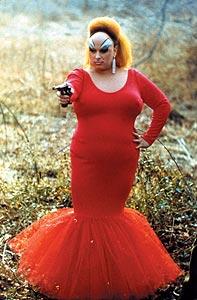
I've just seen the John Waters film Cecil B. Demented. Well, it was OK. Actually I hate the kids, and it was definitely a film made with the kids in mind. But then, if it was propaganda, it was at least propaganda in a righteous cause. John Waters obviously has a lot of respect for Spike Lee. The kids in Cecil B. were standard issue multicultural, which was a bit of a disappointment. The racial politics of Pink Flamingos was much more intriguing. We see Divine going to the post office and striding along the sidewalk. Strange that it's a black neighbourhood. We see the passersby looking astonished, but in a guarded rather than a hostile way. The post office workers are too shocked to say anything. This is the White Queen, maggoty-beautiful, casting all shame to the winds.
By the way, I think the same actor who plays the Chief on the tropical island in Emanuelle in America is the same man who spoons out the eye from the severed head in Emanuelle and the Last Cannibals. Spike Lee's Bamboozled wasn't the first film to mash its teeth into race prejudice, to inhabit its stereotypes to such an extreme degree that they transgress themselves, bursting into liberating pieces. Joe d'Amato (who else?)'s films are a richly coloured travelogue, a wildly-spiced carnival of racial stereotypes driven to their last absurd limits, a racial delirium. And I think that the actors enjoy themselves, by and large. The three above-mentioned directors all prefer to work with a a team they know well, a travelling community of the otherwise unemployable (and in the case of Spike Lee, who else would give African-Americans such decent parts?), forming a supportive environment for the creation of a liberated community.
The carnival of perversion, dreams of miscegenation. Divine with the giant lobster. The best scene in the oeuvre.
Sombre too, as we watch the black minstrels burning the cork before the mirror, the candle flame shining in the curve of the spoon. And in the shots of the toys and little ornaments at the end of Bamboozled, we see the complexity and strangeness of hatred, the eerie fascination of these defunct, absurd objects. Seeing the sequence of old films, silent-era, talkies and cartoons, all showing negroes in absurd or demeaning roles, one wants somehow to reach out and pay some sort of honour to the players. Why is this? Some sort of yearning, not guilt or self-hatred, not sentimentality either, exactly. A girl with a scarf on her head, looking out to the left and smiling, how well-observed it is, and how tenderly moulded. Are black people better observers of whites than vice versa? Compassion arises from precise observation, from simply deciding to look. In all these objects (many from Spike Lee's own collection), we see something divided aginst itself - complex, hostile, and full of longing.
By the way, I think the same actor who plays the Chief on the tropical island in Emanuelle in America is the same man who spoons out the eye from the severed head in Emanuelle and the Last Cannibals. Spike Lee's Bamboozled wasn't the first film to mash its teeth into race prejudice, to inhabit its stereotypes to such an extreme degree that they transgress themselves, bursting into liberating pieces. Joe d'Amato (who else?)'s films are a richly coloured travelogue, a wildly-spiced carnival of racial stereotypes driven to their last absurd limits, a racial delirium. And I think that the actors enjoy themselves, by and large. The three above-mentioned directors all prefer to work with a a team they know well, a travelling community of the otherwise unemployable (and in the case of Spike Lee, who else would give African-Americans such decent parts?), forming a supportive environment for the creation of a liberated community.
The carnival of perversion, dreams of miscegenation. Divine with the giant lobster. The best scene in the oeuvre.
Sombre too, as we watch the black minstrels burning the cork before the mirror, the candle flame shining in the curve of the spoon. And in the shots of the toys and little ornaments at the end of Bamboozled, we see the complexity and strangeness of hatred, the eerie fascination of these defunct, absurd objects. Seeing the sequence of old films, silent-era, talkies and cartoons, all showing negroes in absurd or demeaning roles, one wants somehow to reach out and pay some sort of honour to the players. Why is this? Some sort of yearning, not guilt or self-hatred, not sentimentality either, exactly. A girl with a scarf on her head, looking out to the left and smiling, how well-observed it is, and how tenderly moulded. Are black people better observers of whites than vice versa? Compassion arises from precise observation, from simply deciding to look. In all these objects (many from Spike Lee's own collection), we see something divided aginst itself - complex, hostile, and full of longing.

The Pulley
When God at first made man,
Having a glass of blessings standing by,
Let us (said he) pour on him all we can:
Let the world's riches, which dispersed lie,
Contract into a span.
So strength first made a way;
Then beauty flowed, then wisdom, honour, pleasure:
When almost all was out, God made a stay,
Perceiving that alone of all his treasure
Rest in the bottom lay.
For if I should (said he)
Bestow this jewel also on my creature,
He would adore my gifts instead of me,
And rest in nature, not the God of Nature:
So both should losers be.
Yet let him keep the rest,
But keep them with repining restlessness:
Let him be rich and weary, that at least,
If goodness lead him not, yet weariness
May toss him to my breast.
George Herbert, from The Temple 1633
When God at first made man,
Having a glass of blessings standing by,
Let us (said he) pour on him all we can:
Let the world's riches, which dispersed lie,
Contract into a span.
So strength first made a way;
Then beauty flowed, then wisdom, honour, pleasure:
When almost all was out, God made a stay,
Perceiving that alone of all his treasure
Rest in the bottom lay.
For if I should (said he)
Bestow this jewel also on my creature,
He would adore my gifts instead of me,
And rest in nature, not the God of Nature:
So both should losers be.
Yet let him keep the rest,
But keep them with repining restlessness:
Let him be rich and weary, that at least,
If goodness lead him not, yet weariness
May toss him to my breast.
George Herbert, from The Temple 1633

The poet prays to the Virgin for help
I pray to the Divine Mother of God,
Heavenly Queen of all living things,
that she grant me the pure light of the little animals
that have a single letter in their vocabulary.
Animals without souls. Simple shapes.
Far from the cat's despicable knowledge.
Far from the owl's fictitious profundity.
Far from the horse's sculptural wisdom.
Creatures that love without eyes,
with a single sense of infinity's waves,
that gather in great piles
to be eaten by birds.
Grant me the single dimension
that little flat animals have
so that I can tell of things covered with earth
beneath the hard innocence of the shoe.
No one weeps because he understands
the millions of tiny deaths at the marketplace,
the Chinese multitude of headless onions,
and that great yellow sun of old, flattened fish.
You, Mother, forever to be feared. Whale of all the skies,
You, Mother, forever joking. Neighbour of the borrowed parsley.
You know that to speak of the world
I must understand its slightest flesh.
Federico Garcia Lorca
from Lecture: Poet in New York
(translated by Christopher Maurer)
Heavenly Queen of all living things,
that she grant me the pure light of the little animals
that have a single letter in their vocabulary.
Animals without souls. Simple shapes.
Far from the cat's despicable knowledge.
Far from the owl's fictitious profundity.
Far from the horse's sculptural wisdom.
Creatures that love without eyes,
with a single sense of infinity's waves,
that gather in great piles
to be eaten by birds.
Grant me the single dimension
that little flat animals have
so that I can tell of things covered with earth
beneath the hard innocence of the shoe.
No one weeps because he understands
the millions of tiny deaths at the marketplace,
the Chinese multitude of headless onions,
and that great yellow sun of old, flattened fish.
You, Mother, forever to be feared. Whale of all the skies,
You, Mother, forever joking. Neighbour of the borrowed parsley.
You know that to speak of the world
I must understand its slightest flesh.
Federico Garcia Lorca
from Lecture: Poet in New York
(translated by Christopher Maurer)
Sunday, October 16, 2005

Tomatsu Shomei - a Japanese photographer, famous for his pictures from the atomic ruins of Nagasaki, black and white pictures full of love for the surfaces of things, for their grain and decay. But his pictures convey real human sympathy too. They are never just dreamy still-lives, but even his inanimate objects have a human vulnerability to them, either warmth, or the coldness of departed life. This picture was taken in 1971, and a whole book of Tomatsu's pictures is available cheap! from Phaidon in their 55 Photographers series.
A beautiful ancient American face

A Mayan ceremonial mask, made of jade and found in a royal tomb. I thought only the Japanese made things as beautiful as this...
(AD 250 - 900)
Bàrd Seòirseach Bhàsia Psiaibheala le theaghlach

Georgian poet Vazha Pshavela (1861 - 1915) with his family

Xochi Pilli

Immeasurable pain!
My dreaming soul last night was king again.
As in past days
I wandered through the Palace of Delight,
And in my dream
Down grassy garden ways
Glided my chariot, smoother than a summer stream.
There was moonlight,
The trees were blossoming,
And a faint wind softened the air of night,
For it was spring.
Arthur Waley

Subscribe to:
Posts (Atom)

